Saturday, December 5, 2009

Friday, December 4, 2009
Bad Things to Good People
Here are some links on the problem of evil.
 There is a collection of resources all about the problem of evil, including criticisms of several different responses to the problem. I mean, wow.
- I'd like to highlight one article in particular: a discussion of the "God works in mysterious ways" response: do we have enough evidence to believe that there is a reason for all the suffering in the world, but humans aren't smart enough to understand what that reason is?
- Thoughts on everyday evil and the Holocaust.
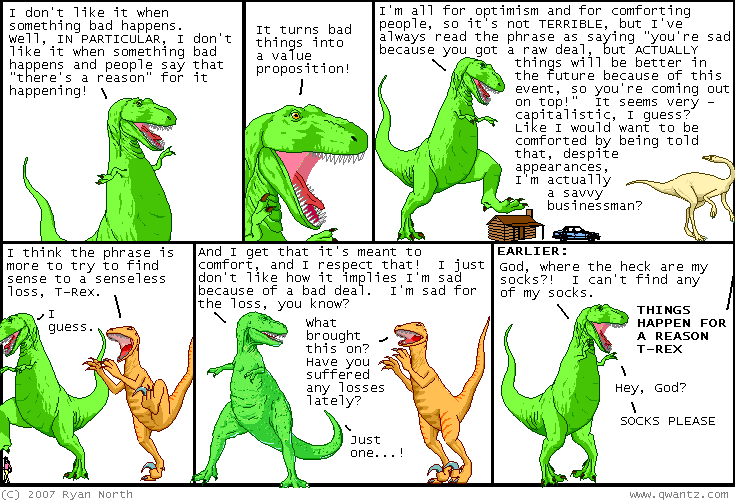
- Does everything happen for a reason? This cartoon dinosaur has an interesting take on that question. (T-Rex also occasionally wonders why bad things happen to nice people, and whether we're in the worst possible world.)
Thursday, December 3, 2009
More With the Creepy Guy
Here are some recommended videos on the design argument from Closer to Truth:

- Philosopher Richard Swinburne likes the design argument. (Part 2 of his interview is here.)
- Philosopher Bede Rundle is less convinced.
- Philosopher Colin McGinn tackles the issue of fine-tuning.
Tuesday, December 1, 2009
Journal Guideline
UPDATE 12/1: New due date!
Here is a guideline for the next big assignment: the journal you have to keep during our discussion of God.
Worth: 15% of your overall grade
New Due Date: the beginning of class onMonday, December 7th, Wednesday, December 16th, 2009
The assignment is to keep a journal during our section on philosophy of religion. I want you to write several short journal entries about the various arguments for and against the existence of God. We’ll be going over all these arguments in class during the next few weeks. Each entry should be around two paragraphs long.
This assignment is a chance for you to do philosophy. I want you to demonstrate that you understand what we are reading and discussing. (Present each argument in your own words.) In addition to this, I want you to critically evaluate each argument we read and discuss. (Are any premises questionable? Does the argument provide enough support for its conclusion?) It is also a chance for you to give your opinion on these arguments, and defend your opinion with good reasons.
You should have the following journal entries, in this order:

Here is a guideline for the next big assignment: the journal you have to keep during our discussion of God.
Worth: 15% of your overall grade
New Due Date: the beginning of class on
The assignment is to keep a journal during our section on philosophy of religion. I want you to write several short journal entries about the various arguments for and against the existence of God. We’ll be going over all these arguments in class during the next few weeks. Each entry should be around two paragraphs long.
This assignment is a chance for you to do philosophy. I want you to demonstrate that you understand what we are reading and discussing. (Present each argument in your own words.) In addition to this, I want you to critically evaluate each argument we read and discuss. (Are any premises questionable? Does the argument provide enough support for its conclusion?) It is also a chance for you to give your opinion on these arguments, and defend your opinion with good reasons.
You should have the following journal entries, in this order:
1) Your first entry on your thoughts about God before discussing any of this stuff in class. Do you think there is a God? Why or why not?The journal does not have to be typed. There is no length requirement. (Again, the suggestion is around two paragraphs per journal entry.)
2) An entry explaining and evaluating the cosmological argument (Aquinas reading).3) An entry explaining and evaluating the ontological argument (Anselm & Guanilo readings).
3) An entry explaining and evaluating the design argument (Hume reading).
4) An entry explaining and evaluating the problem of evil argument (Augustine and B.C. Johnson readings).
5) A final entry where you discuss your thoughts about God after reading these philosophers and discussing this in class. Has your opinion about God changed? Have your reasons for your opinion changed?
Saturday, November 28, 2009
Design in the Mind's Eye
Here's an interesting approach to explaining the seeming complexity, order, and functionality of the universe: maybe it's all in our mind.
Psychologist Paul Bloom argues that we see intentional design and patterns too much... including in things that are actually random. So things that seem so fine-tuned and unlikely from our perspective might not actually be. Here's a video dialogue on this topic:
Bloom has two great books (Descartes' Baby and How Children Learn the Meaning of Words) on how our minds develop from early childhood on.
Psychologist Paul Bloom argues that we see intentional design and patterns too much... including in things that are actually random. So things that seem so fine-tuned and unlikely from our perspective might not actually be. Here's a video dialogue on this topic:
Bloom has two great books (Descartes' Baby and How Children Learn the Meaning of Words) on how our minds develop from early childhood on.
Thursday, November 26, 2009
Her Stroke of Insight
Here's neuroscientist Jill Bolte Taylor's TED talk on her experience of having a stroke that we discussed in class:
Bolte Taylor wrote a whole book on her experience. It's available in most book stores. Here's a more detailed audio interview with her.
I love TED talks. Here are some of my other favorites:
Bolte Taylor wrote a whole book on her experience. It's available in most book stores. Here's a more detailed audio interview with her.
I love TED talks. Here are some of my other favorites:
Tuesday, November 24, 2009
Like a Machine, Only More So
Here are some links on the design argument for God's existence.
- Here is a nice explanation of the design argument, along with an explanation of the wacky arg for god's existence that we were supposed to study, but are skipping.
- Here is an audio interview on Hume's criticisms of the design arg.
- One philosophers' take on the debate between evolution and intelligent design.
- Is our universe fine-tuned for life? Maybe not.
- Wait, can science even judge religious claims, or are they talking about different things? Maybe an inference to the best explanation can help us...
- What about all the "design flaws" in nature? Are they evidence against a supreme designer?
- Well, recent research might show the appendix serves a purpose, and so wouldn't count as a design flaw.

Thursday, November 19, 2009
The Universe Began, Again
Still wondering whether the universe has a beginning or regresses infinitely? Here's an entire episode of Closer to Truth devoted to the question "Did the Universe Have a Beginning?" If you can get past the weird host, there are some nice explanations of the science of the origins of the universe by current cosmologists.

Wednesday, November 18, 2009
Torturing Puppies, Eating Meat
Here's the article we discussed in class that compared torturing puppies and eating meat from factory farms: "Puppies, Pigs, and People: Eating Meat and Marginal Cases" by Alistair Norcross.
So just because we ran out of time in class doesn't mean we should stop discussing this issue (or any other issue, for that matter). Any more thoughts or questions on this topic? Let us know in a comment to this post.
Also, here are some links on animal ethics:

So just because we ran out of time in class doesn't mean we should stop discussing this issue (or any other issue, for that matter). Any more thoughts or questions on this topic? Let us know in a comment to this post.
Also, here are some links on animal ethics:
- David Foster Wallace: Consider the Lobster
- How to Cut Back on Meat Slowly
- What Is The Meatrix?
- What If We Could Make Pain-Free Animals?
- So Torture's Bad... But How About Killing Non-Persons?
- What About Animal Research?
- How About Dog Fighting?
- Vegetarians Still Love the Smell of Bacon
- Audio Interview with Peter Singer
- Michael Pollan's "An Animal's Place"
- Huge List of Resources on the Moral Status of Animals
Tuesday, November 17, 2009
Infinite Regression Analysis
So thanks to some great analysis in class, we figured out that Aquinas's argument for the impossibility of an infinite regress commits the fallacy of equivocation. This means that a word or phrase shifts meanings halfway through an argument. It's treating two different things as if they're the same by using the same words to refer to them. Equivocation creates the false impression that there's a logically strong relationship (the relationship of identity!) in the argument when there actually isn't.
My best friend the inter-net has some nice examples of equivocation. Here are two good ones:
Second, we're back to square one in this version of the cosmological argument. Aquinas's argument against an infinite regress is bad, so his 2nd premise in the cosmological argument is questionable. (NOTE: that doesn't mean that an infinite regress is possible, just that he hasn't disproven it's possibility with his line of reasoning.)
Regardless, an infinite regress still seems weird. If Aquinas's arg didn't work, why else might we think that an infinite regress is impossible?
Discuss your arguments in the comments of this post.
My best friend the inter-net has some nice examples of equivocation. Here are two good ones:
- P1) A feather is light.
- P2) What is light cannot be dark.
C) Thus, a feather cannot be dark. - P1) Samantha is a jackass.
- P2) All jackasses have long ears.
- C) Thus, Samantha has long ears.
Second, we're back to square one in this version of the cosmological argument. Aquinas's argument against an infinite regress is bad, so his 2nd premise in the cosmological argument is questionable. (NOTE: that doesn't mean that an infinite regress is possible, just that he hasn't disproven it's possibility with his line of reasoning.)
Regardless, an infinite regress still seems weird. If Aquinas's arg didn't work, why else might we think that an infinite regress is impossible?
Discuss your arguments in the comments of this post.
Subscribe to:
Posts (Atom)