Wednesday, September 30, 2009

Paper #1 Guidelines

(Want tips on writing a philosophy essay? Check out here and here!)

Due Date:
Wednesday Friday, October 23rd, 2009

Worth: 50 points (5% of final grade)

Assignment: Write an argumentative essay on one of the topics below. Papers must be typed, and must be between 300-600 words long. Provide a word count on the first page of the paper. (Most programs like Microsoft Word & WordPerfect have automatic word counts.)

Possible Paper Topics
1. Criticize skepticism of the external world. Describe what you take to be the best argument for external-world skepticism. Then evaluate this argument. How is this argument unsuccessful? What is/are its flaw(s)? How can we avoid giving in to the skeptic’s arguments that we don’t know anything about the world?
[NOTE: For this option, you don’t have to present a positive argument for the existence of the external world. Just explain why the skeptical argument you focus on is bad.]

2. Present and defend an argument for the claim that we can know that there is an external world outside our sense data. Be sure to consider and respond to objections to your argument that a skeptic would likely offer.

3. Defend external-world skepticism. Present an argument for external-world skepticism. Then consider and respond to objections to this argument. Pay special attention to your conception of knowledge: defend the conditions you believe are required for knowledge.

4. Explain and evaluate Nick Bostrom’s argument in “Do We Live in a Computer Simulation?” Do you think he makes a good case for external-world skepticism? Why or why not? Be sure to fully explain your evaluation of his argument, and defend your opinion.

5. Write on an epistemological topic of your choosing. (Sean must approve this topic by Wedneday, October 14th.)

apparently this cat believes certainty is a requirement for knowledge

Tuesday, September 29, 2009

Evaluating Deductive Args

Here are the answers to the handout on evaluating arguments that we did as group work in class. Perhaps I should have titled the handout "So Many Bad Args!"

1) All humpback whales are whales.
All whales are mammals.
All humpback whales are mammals.
P1- true
P2- true
structure- good
overall - good
2) (from Stephen Colbert)
Bush was either a great prez or the greatest prez.
Bush wasn’t the greatest prez.
Bush was a great prez.
P1- questionable ("great" is subjective)
P2- questionable ("great" is subjective)
structure- good (it's either A or B; it's not A; so it's B)
overall- bad (bad premises)
3) Some cats can speak German.
Sean has a cat.
Sean's cat can speak German.2 Cute
P1- false
P2- true! (I have two; there they are! ------------>)
structure- bad (the 1st premise only says some can speak German; Sean's cat could be one of the ones that doesn't)
overall- bad (bad structure)
4) All knock-knock jokes are annoying.
Some knock-knock jokes are funny.
Some annoying things are funny.
P1- questionable ("annoying" is subjective)
P2- questionable ("funny" is subjective)
structure- good (the premises establish that some knock-knock jokes are both annoying and funny; so some annoying things [those jokes] are funny)
overall - bad (bad premises)
5) All whales are mammals.
All whales live in the ocean.
All mammals live in the ocean.
P1- true
P2- true (if interpreted to mean "Whales are the sorts of creatures whose natural habitat is the ocean.") or false (if interpreted to mean "Each and every living whale lives in the ocean," since some whales, like Shamu, live in SeaWorld or other zoos)
structure
- bad (we don't know much about the relationship between mammals and creatures that live in the ocean just from the fact that whales belong to each of those groups)
overall- bad (bad structure)
6) Some dads have beards.
All bearded people are mean.
Some dads are mean.
P1- true
P2- questionable ("mean" is subjective)
structure- good (if all the people with beards were mean, then the dads with beards would be mean, so some dads would be mean)
overall- bad (bad 2nd premise)
7) This class is boring.
All boring things are taught by Sean
This class is taught by Sean.
P1-questionable ("boring" is subjective)
P2- false (nearly everyone would agree that there are some boring things not associated with your teacher Sean)
structure- good
overall- bad (bad premises)
8) All students in this room are mammals.
All humans are mammals.
All students in this room are humans.
P1- true
P2- true
structure
- bad (it's the same structure as argument #10 below; the premises only tell us that students and humans both belong to the mammals group; we don't know enough about the relationship between students and humans from this; for instance, what if a dog were a student in our class?)
overall- bad (bad structure)

Scary?9) All hornets are wasps.
All wasps are insects.
All insects are scary.
All hornets are scary.
P1- true!
P2- true
P3- questionable ("scary" is subjective)
structure- good (same structure as in argument #1, just with an extra premise)
overall- bad (bad 3rd premise)
10) All women are mammals.
All men are mammals.
All men are women.
P1- true
P2- true
structure- bad (just because men and women belong to the same group doesn't mean that men are women; same bad structure as in arg #8)
overall- bad (bad structure)
11) If Sean sings, then students cringe.
Sean is singing right now.
Students are cringing right now.
P1- questionable (since you haven't heard me sing, you don't know whether it's true or false)
P2- false (I'm not singing now!)
structure- good
overall- bad (bad premises)
12) If Sean sings, then students cringe.
Sean isn't singing right now.
Students aren't cringing right now.
P1- questionable (again, you don't know)
P2- true
structure- bad
(from premise 1, we only know what happens when Sean is singing, not when he isn't singing; students could cringe for a different reason)
overall- bad (bad 1st premise and structure)
13) If Sean sings, then students cringe.
Students aren't cringing right now.
Sean isn't singing right now.
P1- questionable (again, you don't know)
P2- true
structure- good
overall- bad (bad 1st premise)
14) If Sean sings, then students cringe.
Students are cringing right now.
Sean is singing right now.
P1- questionable (again, you don't know)
P2- false
structure- bad
(from premise 1, we only know that Sean singing is one way to guarantee that students cringe; just because they're cringing doesn't mean Sean's the one who caused it; again, students could cringe for a different reason)
overall- bad (bad premises and structure)

Monday, September 28, 2009

Non-Deductive Args

Here are the answers to the group work we did in class on args by example, args by analogy, args from authority, and args about causes. Conclusions are in bold.

1. That Honus Wagner baseball card shouldn’t be that valuable. After all, it’s made out of cardboard, and cardboard boxes at Pathmark are super cheap.
Analogy
Bad - Material isn't always a relevant similarity to draw a conclusion about value: baseball cards are typically valued for their rarity, not what they're made of.
2. Canada, Mexico, USA, India, and Australia are all countries that border oceans on the east and west. Hence, most countries border oceans on both the east and west.
Example
Bad - 5 countries out of about 200 total nations is too small a sample. Also, the examples are cherry-picked, and so they're unrepresentative.
3. In a recent study, 100% of those who took a new birth control pill didn’t get pregnant. Only males participated in the study. Thus, the birth control pill must be very effective.
Cause
Bad - A better explanation of the correlation between taking the pill and not getting pregnant is that males don't get pregnant.
4. Oasis sounds just like The Beatles. We all know that The Beatles were one of the most influential rock bands ever. So Oasis must be one of the most influential bands, too.
Analogy
Bad - A similar sound isn't a relevant enough similarity regarding whether a band is influential.
5. Abortion is morally acceptable because renowned linguist Noam Chomsky has defended the practice of abortion, and he’s pretty smart.
Authority
Bad - Chomsky's expertise (linguistics) isn't relevant to the topic of abortion.
6. Most people say the money it costs to go to law school is worth it, because lawyers earn a lot of money. So, since doctors also earn a lot, med school costs must be worth it, too.
Analogy
Pretty Good - The similarity (average money earned per profession) is relevant to whether med school is financially worth it. Assuming one thinks a large up-front investment is worth an even larger salary in the future, this arg is good.
7. My friend knows me better than anyone else, and he says I’m a decent guy. Therefore, I must be a decent guy.
Authority
Bad - Yes, my friend is a relevant expert, but he's likely to be biased in favor of me since he is my friend.
8. My sis usually keeps her car windows rolled down, though she always rolls them up right before it rains. Her car must be magical, then: rolling up her windows causes it to rain.
Cause
Bad - This is reversed! The rain probably causes her to roll up her window, not the other way around.
Nashville's Finest Souvenir9. This guitar-shaped flyswatter costs $2 more than that normal one. Most of the expensive stuff I’ve bought in the past turned out to be higher quality than similar, cheaper items. Hence, the guitar-shaped swatter is higher quality than the normal one.
Example
Bad - While there may be a general correlation between expense and quality, it is not representative of this kind of novelty item. There is also a correlation between price and novelty: the more unique an object is, the more expensive it typically is.
10. Nearly every time I see Conan O’Brien on television, I wind up falling asleep. Thus, I guess Conan puts me to sleep.
Cause
Bad - Another way to explain this correlation between Conan and my sleep is the fact that his show is on late at night, a time at which I'm usually tired anyway.

Thursday, September 24, 2009

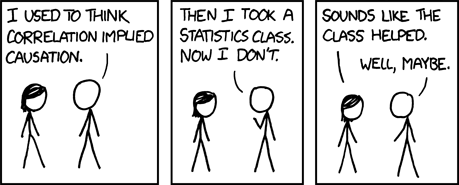
Correlationships

Here are some headier links related to the arguments we've been going over in class:
Correlation

Wednesday, September 23, 2009

Lonely Quiz

The quiz will be held at the beginning of class on Wednesday, September 30th. You'll have 25 minutes to take it, and it's worth 10% of your overall grade.

The quiz is on our tiny textbook (A Rulebook for Arguments). There will be a section on evaluating deductive arguments, and a section on evaluating the other kinds of arguments (example, analogy, authority, cause). Basically, the quiz will look a lot like the group work we've done in class so far.

That's No Way To Treat A Philosopher-Baby!

Tuesday, September 22, 2009

Penguin Digestion Experts? You Bet!

So you didn't believe me when I said that there are experts on the subject of penguin digestion? Oh, you did? Fine, well, I'll prove it to you, anyway. Here are some academic articles on the topic:
Of course, no list would be complete without the often-cited, groundbreaking 1985 Ornis Scandinavica article:
Perhaps my favorite, though, is the following:
If any of these articles are above your head (I think they're all above mine!), you might like this, uh, simpler video demonstration of penguin digestion.

Saturday, September 19, 2009

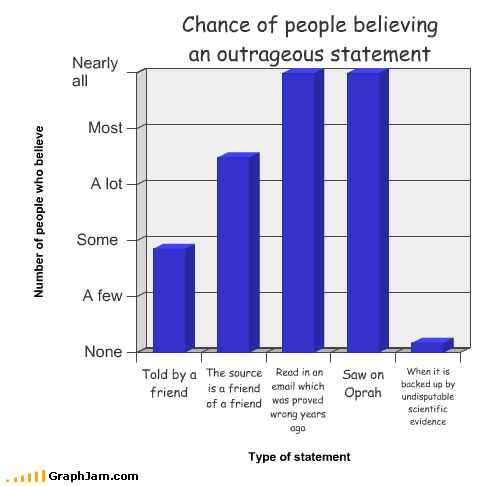
Check the Source

Yeah, she was there, or read it in a book, or something

-via GraphJam

Wednesday, September 16, 2009

Because One Stick-Figure Comic Isn't Enough...

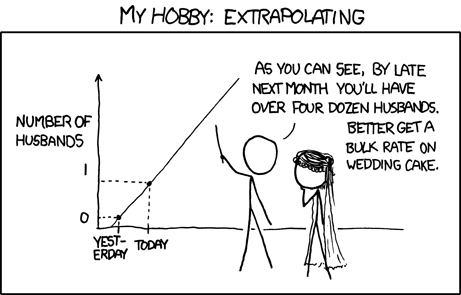
What's wrong with the following argument?

By the third trimester, there will be hundreds of babies inside you.

Let us know in the comments!

Arguments by Example

Here's a few dumb things about arguments by example (also called inductive arguments, talked about in the book chapter titled "Generalizations"). First, a video of comedian Lewis Black describing his failure to learn from experience every year around Halloween:


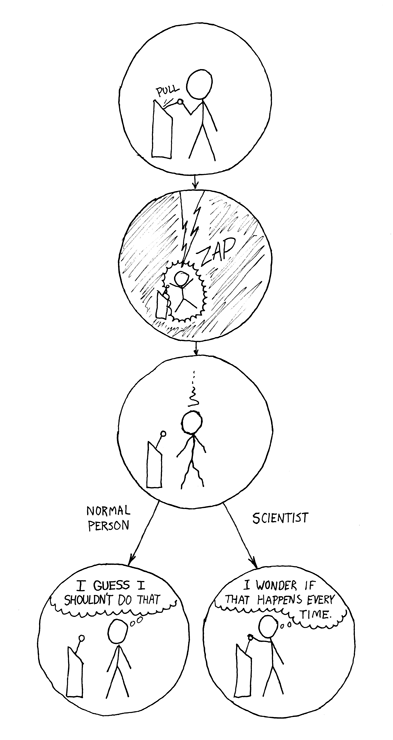
And here's a stick figure comic about scientists' efforts to get as big a sample size as they can to improve their arguments.

I Hope That First Pull Wasn't Representative

Tuesday, September 15, 2009

Structure

One of the trickier concepts to understand in this course is the structure of an argument. This is a more detailed explanation of the term. If you've been struggling to understand this term, the following might help you.

An argument's structure is its underlying logic; the way the premises and conclusion logically relate to one another. The structure of an argument is entirely separate from the actual meaning of the premises. For instance, the following three arguments, even though they're talking about different things, have the exact same structure:

1) All tigers have stripes.
Tony is a tiger.
Tony has stripes.

2) All humans have wings.
Sean is a human.
Sean has wings.

3) All blurgles have glorps.
Xerxon is a blurgle.
Xerxon has glorps.

There are, of course, other, non-structural differences in these three arguments. For instance, the tiger argument is overall good, since it has a good structure AND true premises. The human/wings argument is overall bad, since it has a false premise. And the blurgles argument is just crazy, since it uses made up words. Still, all three arguments have the same underlying structure (a good structure):

All A's have B's.
x is an A.
x has B's.

Evaluating the structure of an argument is tricky. Here's the main idea regarding what counts as a good structure: the premises, if they were true, would provide good evidence for us to believe that the conclusion is true. So, if you believed the premises, they would convince you that the conclusion is worth believing, too.

Note I did NOT say that the premises are actually true in a good-structured argument. Structure is only about truth-preservation, not about whether the premises are actually true or false. What's "truth preservation" mean? Well, truth-preserving arguments are those whose structures guarantee that if you stick in true premises, you get a true conclusion.

The premises you've actually stuck into this particular structure could be good (true) or bad (false). That's what makes evaluating an arg's structure so weird. To check the structure, you have to ignore what you actually know about the premises being true or false.

Good Structured Deductive Args (Valid)
If we assume that all the premises are true, then the conclusion must also be true for an argument to have a good structure. Notice we are only assuming truth, not guaranteeing it. Again, this makes sense, because we’re truth-preservers: if the premises are true, the conclusion that follows must be true.

EXAMPLES:
1) All humans are mammals.
All mammals have hair.
All humans have hair.

2) If it snows, then it’s below 32 degrees.
It is snowing right now.
It’s below 32 degrees right now.

3) All humans are mammals.
All mammals have wings.
All humans have wings.

4) Either Yao is tall or Spud is tall.
Yao is not tall.
Therefore, Spud is tall.

Even though arguments 3 and 4 are ultimately bad, they still have good structure (their underlying form is good). The second premise of argument 3 is false—not all mammals have wings—but it has the same exact structure of argument 1—a good structure. Same with argument 4: the second premise is false (Yao Ming is about 7 feet tall), but the structure is good (it’s either this or that; it’s not this; therefore, it’s that).

To evaluate the structure, then, assume that all the premises are true. Imagine a world in which all the premises are true. In that world, MUST the conclusion also be true? Or can you imagine a scenario in that world in which the premises are true, but the conclusion is still false? If you can imagine this situation, then the argument's structure is bad. If you cannot, then the argument is truth-preserving (inputting truths guarantees a true output), and thus the structure is good.

Bad Structured Deductive Args (Invalid)
In an argument with a bad structure, you can’t draw the conclusion from the premises – they don’t naturally follow. Bad structured arguments do not preserve truth.

EXAMPLES:
1) All humans are mammals.
All whales are mammals.
All humans are whales.

2) If it snows, then it’s below 32 degrees.
It doesn’t snow.
It’s not below 32 degrees.

3) All humans are mammals.
All students in our class are mammals.
All students in our class are humans.

4) Either Yao is tall or Spud is short.
Yao is tall.
Spud is short.

Even though arguments 3 and 4 have all true premises and a true conclusion, they are still have a bad structure, because their form is bad. Argument 3 has the same exact structure as argument 1—a bad structure (it doesn’t preserve truth).

Even though in the real world the premises and conclusion of argument 3 are true, we can imagine a world in which all the premises of argument 3 are true, yet the conclusion is false. For instance, imagine that our school starts letting whales take classes. The second premise would still be true, but the conclusion would then be false.

The same goes for argument 4: even though Spud is short (Spud Webb is around 5 feet tall), this argument doesn’t guarantee this. The structure is bad (it’s either this or that; it’s this; therefore, it’s that, too.). We can imagine a world in which Yao is tall, the first premise is true, and yet Spud is tall, too.

Good or Bad Structure?

Wednesday, September 9, 2009

Club Meeting

Own It!So, I run a club called "Owning Our Ignorance" that's devoted to fun and reasoning, but more funning than reasoning. Shut up, "funning" is too a word.

We're having our first meeting of the school year Sunday night at the Barnes & Noble in Deptford. More info on the meeting and the club are available here.

If you're interested, come on out!

Sunday, September 6, 2009

Definitions of "Philosophy"

Here are some videos on the definitions of the word "philosophy" that we discussed in class. First, the Bobby Brown definition: Nothing says "philosophy as a worldview" like 1988 Bobby Brown.


Bobby Brown - My Prerogative

Now for the 3-year-old definition. Here's comedian Louis CK's take on the broad, fundamental questions kids ask.

Louis CK - Why?

And here's what springs to my mind when I think about doing philosophy:

I Wonder If That's A Bubble Pipe

Wednesday, September 2, 2009

Email Subscription

So why does this course have a blog? Well, why is anything anything?

A blog (short for “web log”) is a website that works like a journal – users write posts that are sorted by date based on when they were written. You can find important course information (like assignments, due dates, reading schedules, etc.) on the blog. I’ll also be updating the blog throughout the semester, posting interesting items related to the stuff we’re currently discussing in class. You don't have to visit the blog if you don't want to. It's just a helpful resource. I've used a blog for this course a lot, and it's seemed helpful. Hopefully it can benefit our course, too.

Since I’ll be updating the blog a lot throughout the semester, you should check it frequently. There are, however, some convenient ways to do this without simply going to the blog each day. The best way to do this is by getting an email subscription, so any new blog post I write automatically gets emailed to you. (You can also subscribe to the rss feed, if you know what that means.) To get an email subscription:

1. Go to http://cccphilosophy09.blogspot.com.

2. At the main page, enter your email address at the top of the right column (under “EMAIL SUBSCRIPTION: Enter your Email”) and click the "Subscribe me!" button.

3. This will take you to a new page. Follow the directions under #2, where it says “To help stop spam, please type the text here that you see in the image below. Visually impaired or blind users should contact support by email.” Once you type the text, click the "Subscribe me!" button again.

4. You'll then get an email regarding the blog subscription. (Check your spam folder if you haven’t received an email after a day.) You have to confirm your registration. Do so by clicking on the "Click here to activate your account" link in the email you receive.

5. This will bring you to a page that says "Your subscription is confirmed!" Now you're subscribed.

If you are unsure whether you've subscribed, ask me (609-980-8367; slandis@camdencc.edu). I can check who's subscribed and who hasn't.

Laptop Kitty