- Does physical or mental continuity matter? Let's think about teletransportation...
- Perhaps our identity is all in the way we're arranged:
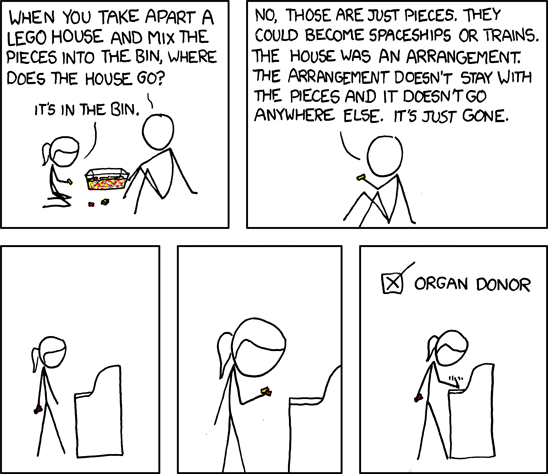
Wednesday, December 16, 2009
My Identity Is Personal
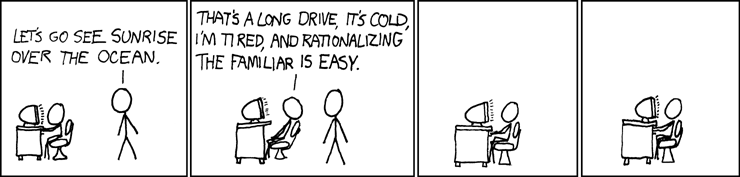
Two cartoons on personal identity:

Tuesday, December 15, 2009
Final Exam
Just a reminder that the final exam is Friday, December 18th, at 11:00 a.m. in our normal classroom. You'll have 50 minutes to take it.
After that, we're done! Then, time to enjoy your break. COMMENCE WINTER-TIME ENJOYMENTATIONALIZING...NESS.

After that, we're done! Then, time to enjoy your break. COMMENCE WINTER-TIME ENJOYMENTATIONALIZING...NESS.
Sunday, December 13, 2009
12/14 Class Canceled
I'm sick, so Monday's class is canceled. This confuses a few things logistically, so here are the changes:

- You can hand in your journal on either Wednesday (12/16) or Friday (12/18).
- The group presentations on personal identity and Nietzsche will now go on Wednesday, December 16th.
- The final exam will still be Friday, December 18th, and we'll still be reviewing for it in class on Wednesday.
Nihilism, Like Life, Is Absurd
Here is one (mildly depressing) approach to the meaning of life that our group referenced:

- "The Myth of Sisyphus" by Albert Camus
- "The Absurd" by Thomas Nagel
Friday, December 11, 2009
Faith & Reason: Strange Bedfellows?
For more on today's presentation:
- "The Ethics of Belief," William Clifford's classic argument for evidentialism
- "The Will to Believe," William James's nonevidentialist response to Clifford
- "Believing Without Evidence," a modern-day evidentialist's take on the Clifford-James debate
Thursday, December 10, 2009
It Pays to Believe?
 Here are some links on Pascal's Wager:
- Links to several articles on the argument.
- Here's an audio interview on the argument and Pascal's entire work Pensées.
- NOTHING TO LOSE? Is there really not much to lose in this wager? This cartoon thinks otherwise.
- WHICH GOD? With so many religions out there, which God should we believe in? This cartoon dinosaur has the most practical solution.
- More on decision theory, the branch of math Pascal uses to argue that belief in God is a good bet.
- Some related entries in the Stanford Encyclopedia of Philosophy: evidentialism vs. nonevidentialism, religious versions of nonevidentialism (or fideism), other pragmatic arguments for believing in god, and Pascal's other contributions to philosophy.

Monday, December 7, 2009
Hear No Evil
If you like to get philosophical on the treadmill, try downloading and listening to these podcasts on the problem of evil:

- Well-known contemporary philosopher (and ordained priest) Marilyn McCord Adams offers some insights into the problem of evil in this audio interview. (Download)
- The NPR program Fresh Air has an audio interview with Bart Ehrman on the problem of suffering. (Download)
- Here's even more audio from a few philosophers on the problem of suffering. (Download)
Saturday, December 5, 2009
Friday, December 4, 2009
Bad Things to Good People
Here are some links on the problem of evil.
 There is a collection of resources all about the problem of evil, including criticisms of several different responses to the problem. I mean, wow.
- I'd like to highlight one article in particular: a discussion of the "God works in mysterious ways" response: do we have enough evidence to believe that there is a reason for all the suffering in the world, but humans aren't smart enough to understand what that reason is?
- Thoughts on everyday evil and the Holocaust.
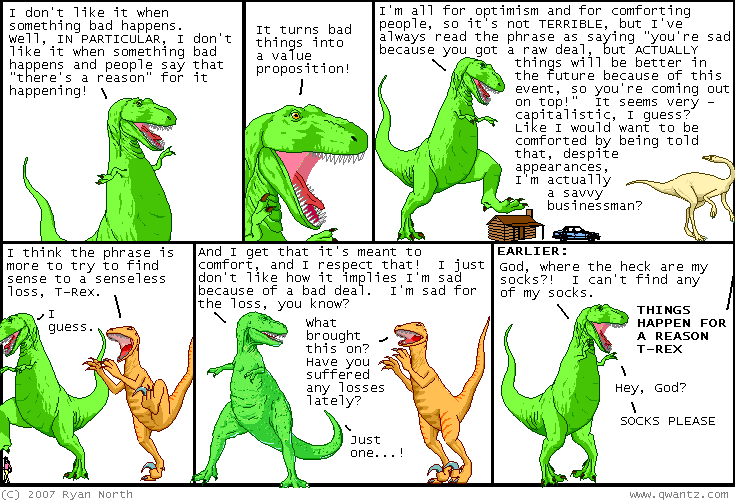
- Does everything happen for a reason? This cartoon dinosaur has an interesting take on that question. (T-Rex also occasionally wonders why bad things happen to nice people, and whether we're in the worst possible world.)
Thursday, December 3, 2009
More With the Creepy Guy
Here are some recommended videos on the design argument from Closer to Truth:

- Philosopher Richard Swinburne likes the design argument. (Part 2 of his interview is here.)
- Philosopher Bede Rundle is less convinced.
- Philosopher Colin McGinn tackles the issue of fine-tuning.
Tuesday, December 1, 2009
Journal Guideline
UPDATE 12/1: New due date!
Here is a guideline for the next big assignment: the journal you have to keep during our discussion of God.
Worth: 15% of your overall grade
New Due Date: the beginning of class onMonday, December 7th, Wednesday, December 16th, 2009
The assignment is to keep a journal during our section on philosophy of religion. I want you to write several short journal entries about the various arguments for and against the existence of God. We’ll be going over all these arguments in class during the next few weeks. Each entry should be around two paragraphs long.
This assignment is a chance for you to do philosophy. I want you to demonstrate that you understand what we are reading and discussing. (Present each argument in your own words.) In addition to this, I want you to critically evaluate each argument we read and discuss. (Are any premises questionable? Does the argument provide enough support for its conclusion?) It is also a chance for you to give your opinion on these arguments, and defend your opinion with good reasons.
You should have the following journal entries, in this order:

Here is a guideline for the next big assignment: the journal you have to keep during our discussion of God.
Worth: 15% of your overall grade
New Due Date: the beginning of class on
The assignment is to keep a journal during our section on philosophy of religion. I want you to write several short journal entries about the various arguments for and against the existence of God. We’ll be going over all these arguments in class during the next few weeks. Each entry should be around two paragraphs long.
This assignment is a chance for you to do philosophy. I want you to demonstrate that you understand what we are reading and discussing. (Present each argument in your own words.) In addition to this, I want you to critically evaluate each argument we read and discuss. (Are any premises questionable? Does the argument provide enough support for its conclusion?) It is also a chance for you to give your opinion on these arguments, and defend your opinion with good reasons.
You should have the following journal entries, in this order:
1) Your first entry on your thoughts about God before discussing any of this stuff in class. Do you think there is a God? Why or why not?The journal does not have to be typed. There is no length requirement. (Again, the suggestion is around two paragraphs per journal entry.)
2) An entry explaining and evaluating the cosmological argument (Aquinas reading).3) An entry explaining and evaluating the ontological argument (Anselm & Guanilo readings).
3) An entry explaining and evaluating the design argument (Hume reading).
4) An entry explaining and evaluating the problem of evil argument (Augustine and B.C. Johnson readings).
5) A final entry where you discuss your thoughts about God after reading these philosophers and discussing this in class. Has your opinion about God changed? Have your reasons for your opinion changed?
Saturday, November 28, 2009
Design in the Mind's Eye
Here's an interesting approach to explaining the seeming complexity, order, and functionality of the universe: maybe it's all in our mind.
Psychologist Paul Bloom argues that we see intentional design and patterns too much... including in things that are actually random. So things that seem so fine-tuned and unlikely from our perspective might not actually be. Here's a video dialogue on this topic:
Bloom has two great books (Descartes' Baby and How Children Learn the Meaning of Words) on how our minds develop from early childhood on.
Psychologist Paul Bloom argues that we see intentional design and patterns too much... including in things that are actually random. So things that seem so fine-tuned and unlikely from our perspective might not actually be. Here's a video dialogue on this topic:
Bloom has two great books (Descartes' Baby and How Children Learn the Meaning of Words) on how our minds develop from early childhood on.
Thursday, November 26, 2009
Her Stroke of Insight
Here's neuroscientist Jill Bolte Taylor's TED talk on her experience of having a stroke that we discussed in class:
Bolte Taylor wrote a whole book on her experience. It's available in most book stores. Here's a more detailed audio interview with her.
I love TED talks. Here are some of my other favorites:
Bolte Taylor wrote a whole book on her experience. It's available in most book stores. Here's a more detailed audio interview with her.
I love TED talks. Here are some of my other favorites:
Tuesday, November 24, 2009
Like a Machine, Only More So
Here are some links on the design argument for God's existence.
- Here is a nice explanation of the design argument, along with an explanation of the wacky arg for god's existence that we were supposed to study, but are skipping.
- Here is an audio interview on Hume's criticisms of the design arg.
- One philosophers' take on the debate between evolution and intelligent design.
- Is our universe fine-tuned for life? Maybe not.
- Wait, can science even judge religious claims, or are they talking about different things? Maybe an inference to the best explanation can help us...
- What about all the "design flaws" in nature? Are they evidence against a supreme designer?
- Well, recent research might show the appendix serves a purpose, and so wouldn't count as a design flaw.

Thursday, November 19, 2009
The Universe Began, Again
Still wondering whether the universe has a beginning or regresses infinitely? Here's an entire episode of Closer to Truth devoted to the question "Did the Universe Have a Beginning?" If you can get past the weird host, there are some nice explanations of the science of the origins of the universe by current cosmologists.

Wednesday, November 18, 2009
Torturing Puppies, Eating Meat
Here's the article we discussed in class that compared torturing puppies and eating meat from factory farms: "Puppies, Pigs, and People: Eating Meat and Marginal Cases" by Alistair Norcross.
So just because we ran out of time in class doesn't mean we should stop discussing this issue (or any other issue, for that matter). Any more thoughts or questions on this topic? Let us know in a comment to this post.
Also, here are some links on animal ethics:

So just because we ran out of time in class doesn't mean we should stop discussing this issue (or any other issue, for that matter). Any more thoughts or questions on this topic? Let us know in a comment to this post.
Also, here are some links on animal ethics:
- David Foster Wallace: Consider the Lobster
- How to Cut Back on Meat Slowly
- What Is The Meatrix?
- What If We Could Make Pain-Free Animals?
- So Torture's Bad... But How About Killing Non-Persons?
- What About Animal Research?
- How About Dog Fighting?
- Vegetarians Still Love the Smell of Bacon
- Audio Interview with Peter Singer
- Michael Pollan's "An Animal's Place"
- Huge List of Resources on the Moral Status of Animals
Tuesday, November 17, 2009
Infinite Regression Analysis
So thanks to some great analysis in class, we figured out that Aquinas's argument for the impossibility of an infinite regress commits the fallacy of equivocation. This means that a word or phrase shifts meanings halfway through an argument. It's treating two different things as if they're the same by using the same words to refer to them. Equivocation creates the false impression that there's a logically strong relationship (the relationship of identity!) in the argument when there actually isn't.
My best friend the inter-net has some nice examples of equivocation. Here are two good ones:
Second, we're back to square one in this version of the cosmological argument. Aquinas's argument against an infinite regress is bad, so his 2nd premise in the cosmological argument is questionable. (NOTE: that doesn't mean that an infinite regress is possible, just that he hasn't disproven it's possibility with his line of reasoning.)
Regardless, an infinite regress still seems weird. If Aquinas's arg didn't work, why else might we think that an infinite regress is impossible?
Discuss your arguments in the comments of this post.
My best friend the inter-net has some nice examples of equivocation. Here are two good ones:
- P1) A feather is light.
- P2) What is light cannot be dark.
C) Thus, a feather cannot be dark. - P1) Samantha is a jackass.
- P2) All jackasses have long ears.
- C) Thus, Samantha has long ears.
Second, we're back to square one in this version of the cosmological argument. Aquinas's argument against an infinite regress is bad, so his 2nd premise in the cosmological argument is questionable. (NOTE: that doesn't mean that an infinite regress is possible, just that he hasn't disproven it's possibility with his line of reasoning.)
Regardless, an infinite regress still seems weird. If Aquinas's arg didn't work, why else might we think that an infinite regress is impossible?
Discuss your arguments in the comments of this post.
Thursday, November 12, 2009
Wacka Wacka
When a philosopher announced that the title of his talk was “Why is there Something rather than Nothing?” Sydney Morgenbesser said to the man sitting next to him, “If there was Nothing he would still complain.”
-from Gerald Dworkin's list of philosophy quips
Saturday, November 7, 2009
Why Is Anything Anything?
The website Closer to Truth has a ton of short interviews with modern-day philosophers (and other smart people) on their thoughts about god. For instance, there's a whole section on the cosmological argument titled "Why Is There Something Rather Than Nothing?" Here are some videos from that section:

- Theist John Leslie says God best explains why there is something.
- Theist Peter van Inwagen believes in God, but doesn't like this arg.
- Atheist Colin McGinn thinks it's a meaningless question.
- Physicist Steven Weisberg says we should wait for science's answer.
- Apatheist Master Shake uses it as an excuse to be lazy.
Thursday, November 5, 2009
Group Presentations
Here are the groups for the end-of-the-semester presentations. I've also included some helpful starter links on your topics. I don't expect you to read them all, but you should at least browse them to see what you might be interested in specifically regarding your topic.
Pascal's Wager (1st on Wednesday, December 9th)
[beginner (plus lots of links)] [intermediate] [advanced] [fun links]
Andrea, Ariel, Caitlyn, Chris, Glenn, Scott
Philosophy of Art (2nd on Wednesday, December 9th)
[beginner] [intermediate] [defining art] [judging art] [music] [conceptual art]
Brian, Charity, Elizabeth, Matt D., Robyn, Todd
Meaning of Life (1st on Friday, December 11th)
[intermediate] [religion links] [Camus's "Myth of Sisyphus"] [Nagel's "The Absurd"] ["Love and Death"] [42?]
Becca, Dan, Dave, Donald, Jim, Kristina
Faith and Reason (1st on Friday, December 11th)
[intermediate] [nonevidentialism] [evidentialism: intermediate, advanced] ["Believing Without Evidence"] ["The Ethics of Belief"] ["The Will to Believe"] [Flew, Hare (reply), & Mitchell (summary)] [lots of links]
Charles, Daisy, Jeff S., Nicole, Sam
Personal Identity (1st on Monday, December 14th)
[intermediate] [advanced] [summary of "A Dialogue on Personal Identity & Immortality"] [identity in general] [Ship of Theseus] [personal identity & ethics]
Eric, Jessica, Joe, L, Marina, Mia, Ta'Neya
Nietzsche (2nd on Monday, December 14th)
[intermediate] [advanced] [common misconceptions] [his ethics & politics] [mega-tons of links]
A.J., Adam, Jeff A., Matt M., Tim
Pascal's Wager (1st on Wednesday, December 9th)
[beginner (plus lots of links)] [intermediate] [advanced] [fun links]
Andrea, Ariel, Caitlyn, Chris, Glenn, Scott
Philosophy of Art (2nd on Wednesday, December 9th)
[beginner] [intermediate] [defining art] [judging art] [music] [conceptual art]
Brian, Charity, Elizabeth, Matt D., Robyn, Todd
Meaning of Life (1st on Friday, December 11th)
[intermediate] [religion links] [Camus's "Myth of Sisyphus"] [Nagel's "The Absurd"] ["Love and Death"] [42?]
Becca, Dan, Dave, Donald, Jim, Kristina
Faith and Reason (1st on Friday, December 11th)
[intermediate] [nonevidentialism] [evidentialism: intermediate, advanced] ["Believing Without Evidence"] ["The Ethics of Belief"] ["The Will to Believe"] [Flew, Hare (reply), & Mitchell (summary)] [lots of links]
Charles, Daisy, Jeff S., Nicole, Sam
Personal Identity (1st on Monday, December 14th)
[intermediate] [advanced] [summary of "A Dialogue on Personal Identity & Immortality"] [identity in general] [Ship of Theseus] [personal identity & ethics]
Eric, Jessica, Joe, L, Marina, Mia, Ta'Neya
Nietzsche (2nd on Monday, December 14th)
[intermediate] [advanced] [common misconceptions] [his ethics & politics] [mega-tons of links]
A.J., Adam, Jeff A., Matt M., Tim
Wednesday, November 4, 2009
God Stuff
If you've read a good article on god stuff, recommend it to us by emailing me or posting the link in the comments section of this post. In the meantime, I have some stuff for you.
How should we approach our discussions about god? Here's one of my favorite essays on this:
Hey, where's the interview with an agnostic? The media are so biased toward those with opinions.

How should we approach our discussions about god? Here's one of my favorite essays on this:
- "Reasonable Religious Disagreements" [pdf] by Richard Feldman
Hey, where's the interview with an agnostic? The media are so biased toward those with opinions.
Friday, October 23, 2009
Midterm Reminder
Just a reminder: the midterm will be held on Wednesday, October 28th. It's worth 20% of your overall grade. There will be a review in class on Monday. It will cover the topics we discussed in class so far: 
- philosophy in general
- doing philosophy
- understanding and evaluating arguments
- types of arguments: deductive, example, analogy, causal, authority
- what is knowledge?
- Plato on knowledge vs. true belief
- skepticism (specifically external world skepticism)
- Descartes battling skepticism
- Descartes's certainty: his arg that "I exist"
- Nick Bostrom's simulation arg for skepticism
BE THERE.
Tuesday, October 20, 2009
Virtual Dino Comic?
Here's a more advanced version of the Nick Bostrom article we're discussing in class about the potentially high probability that we're actually living in a Matrix-like virtual reality. If you get really into Bostrom's argument, there's a whole website devoted to debating it (including a FAQ written by Bostrom).
Of course, T-Rex has read this article, too:

Of course, T-Rex has read this article, too:
Wednesday, October 14, 2009
I'm Certain I'm Doubting

Here are some links related to our discussion of René Descartes and skepticism from class.
 Optical illusion time! Here is a pair of collections of Julian Beever's sidewalk art that looks three-dimensional when viewed from a certain angle. That's a picture of one of his creations above.
- The search for truth is tough. Let's get the FBI on the case!
- Here's an audio interview about Descartes's famous argument that he's certain he exists.
- Can we be abolutely certain of math claims like 2 + 3 = 5? This cartoon dinosaur says we can't!
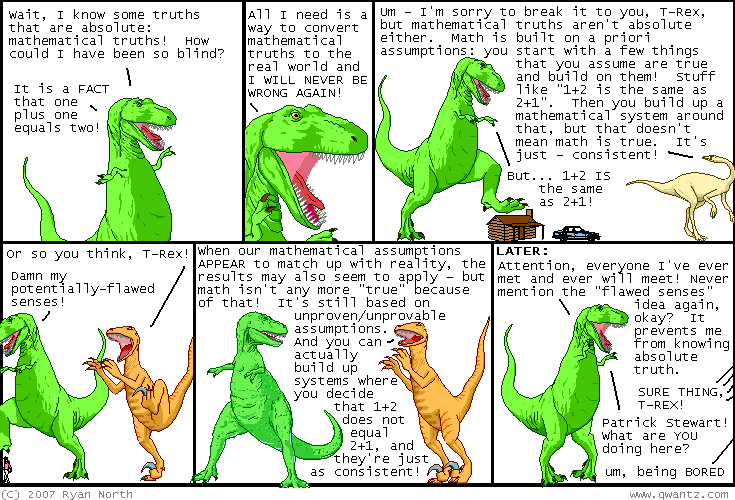
By the way, if you have any links you think I or others in class might find interesting, let me know. And feel free to comment on any of these posts.
Saturday, October 10, 2009
We're All Skeptics Now
Here are some links related to our discussion of knowledge and skepticism from class.
 What are the philosophical implications of the movie The Matrix?
- Here's a summary of the cool argument (pdf) for what I called "unsettled debate" skepticism in class. There's also an entire book on it.
- I recently interviewed the author of that book for the Owning Our Ignorance club. Here's the audio interview.
Monday, October 5, 2009
BS
Want to learn more about bullshit? You can buy Harry Frankfurt's book On Bullshit here... or read it online for free here. Or, be lazy and watch Frankfurt's appearance on The Daily Show.
Some more interviews with Frankfurt about the book are here and here. What do you think? Is not caring about whether you're telling the truth worse than deliberately lying?
Some more interviews with Frankfurt about the book are here and here. What do you think? Is not caring about whether you're telling the truth worse than deliberately lying?
Friday, October 2, 2009
K = JTB?
I wonder whether Plato would agree with T-Rex's analysis of knowledge:

In panel 5, Utahraptor is bringing up a Gettier case counterexample to the claim that knowledge = justified true belief. If you're looking for FUN TIMES, ask me about the Gettier problem in class!
In panel 5, Utahraptor is bringing up a Gettier case counterexample to the claim that knowledge = justified true belief. If you're looking for FUN TIMES, ask me about the Gettier problem in class!
Wednesday, September 30, 2009
Paper #1 Guidelines
(Want tips on writing a philosophy essay? Check out here and here!)
Due Date:Wednesday Friday, October 23rd, 2009
Worth: 50 points (5% of final grade)
Assignment: Write an argumentative essay on one of the topics below. Papers must be typed, and must be between 300-600 words long. Provide a word count on the first page of the paper. (Most programs like Microsoft Word & WordPerfect have automatic word counts.)
Possible Paper Topics
1. Criticize skepticism of the external world. Describe what you take to be the best argument for external-world skepticism. Then evaluate this argument. How is this argument unsuccessful? What is/are its flaw(s)? How can we avoid giving in to the skeptic’s arguments that we don’t know anything about the world?
[NOTE: For this option, you don’t have to present a positive argument for the existence of the external world. Just explain why the skeptical argument you focus on is bad.]
2. Present and defend an argument for the claim that we can know that there is an external world outside our sense data. Be sure to consider and respond to objections to your argument that a skeptic would likely offer.
3. Defend external-world skepticism. Present an argument for external-world skepticism. Then consider and respond to objections to this argument. Pay special attention to your conception of knowledge: defend the conditions you believe are required for knowledge.
4. Explain and evaluate Nick Bostrom’s argument in “Do We Live in a Computer Simulation?” Do you think he makes a good case for external-world skepticism? Why or why not? Be sure to fully explain your evaluation of his argument, and defend your opinion.
5. Write on an epistemological topic of your choosing. (Sean must approve this topic by Wedneday, October 14th.)
Due Date:
Worth: 50 points (5% of final grade)
Assignment: Write an argumentative essay on one of the topics below. Papers must be typed, and must be between 300-600 words long. Provide a word count on the first page of the paper. (Most programs like Microsoft Word & WordPerfect have automatic word counts.)
Possible Paper Topics
1. Criticize skepticism of the external world. Describe what you take to be the best argument for external-world skepticism. Then evaluate this argument. How is this argument unsuccessful? What is/are its flaw(s)? How can we avoid giving in to the skeptic’s arguments that we don’t know anything about the world?
[NOTE: For this option, you don’t have to present a positive argument for the existence of the external world. Just explain why the skeptical argument you focus on is bad.]
2. Present and defend an argument for the claim that we can know that there is an external world outside our sense data. Be sure to consider and respond to objections to your argument that a skeptic would likely offer.
3. Defend external-world skepticism. Present an argument for external-world skepticism. Then consider and respond to objections to this argument. Pay special attention to your conception of knowledge: defend the conditions you believe are required for knowledge.
4. Explain and evaluate Nick Bostrom’s argument in “Do We Live in a Computer Simulation?” Do you think he makes a good case for external-world skepticism? Why or why not? Be sure to fully explain your evaluation of his argument, and defend your opinion.
5. Write on an epistemological topic of your choosing. (Sean must approve this topic by Wedneday, October 14th.)
Tuesday, September 29, 2009
Evaluating Deductive Args
Here are the answers to the handout on evaluating arguments that we did as group work in class. Perhaps I should have titled the handout "So Many Bad Args!"
1) All humpback whales are whales.
All whales are mammals.
All humpback whales are mammals.
1) All humpback whales are whales.
All whales are mammals.
All humpback whales are mammals.
P1- true
P2- true
structure- good
overall - good
2) (from Stephen Colbert)
Bush was either a great prez or the greatest prez.
Bush wasn’t the greatest prez.
Bush was a great prez.
Sean has a cat.
Sean's cat can speak German.
Some knock-knock jokes are funny.
Some annoying things are funny.
All whales live in the ocean.
All mammals live in the ocean.
All bearded people are mean.
Some dads are mean.
All boring things are taught by Sean
This class is taught by Sean.
All humans are mammals.
All students in this room are humans.
 9) All hornets are wasps.
All wasps are insects.
All insects are scary.
All hornets are scary.
All men are mammals.
All men are women.
Sean is singing right now.
Students are cringing right now.
Sean isn't singing right now.
Students aren't cringing right now.
Students aren't cringing right now.
Sean isn't singing right now.
Students are cringing right now.
Sean is singing right now.
Bush was either a great prez or the greatest prez.
Bush wasn’t the greatest prez.
Bush was a great prez.
P1- questionable ("great" is subjective)3) Some cats can speak German.
P2- questionable ("great" is subjective)
structure- good (it's either A or B; it's not A; so it's B)
overall- bad (bad premises)
Sean has a cat.
Sean's cat can speak German.
P1- false4) All knock-knock jokes are annoying.
P2- true! (I have two; there they are! ------------>)
structure- bad (the 1st premise only says some can speak German; Sean's cat could be one of the ones that doesn't)
overall- bad (bad structure)
Some knock-knock jokes are funny.
Some annoying things are funny.
P1- questionable ("annoying" is subjective)5) All whales are mammals.
P2- questionable ("funny" is subjective)
structure- good (the premises establish that some knock-knock jokes are both annoying and funny; so some annoying things [those jokes] are funny)
overall - bad (bad premises)
All whales live in the ocean.
All mammals live in the ocean.
P1- true6) Some dads have beards.
P2- true (if interpreted to mean "Whales are the sorts of creatures whose natural habitat is the ocean.") or false (if interpreted to mean "Each and every living whale lives in the ocean," since some whales, like Shamu, live in SeaWorld or other zoos)
structure- bad (we don't know much about the relationship between mammals and creatures that live in the ocean just from the fact that whales belong to each of those groups)
overall- bad (bad structure)
All bearded people are mean.
Some dads are mean.
P1- true7) This class is boring.
P2- questionable ("mean" is subjective)
structure- good (if all the people with beards were mean, then the dads with beards would be mean, so some dads would be mean)
overall- bad (bad 2nd premise)
All boring things are taught by Sean
This class is taught by Sean.
P1-questionable ("boring" is subjective)8) All students in this room are mammals.
P2- false (nearly everyone would agree that there are some boring things not associated with your teacher Sean)
structure- good
overall- bad (bad premises)
All humans are mammals.
All students in this room are humans.
P1- true
P2- true
structure- bad (it's the same structure as argument #10 below; the premises only tell us that students and humans both belong to the mammals group; we don't know enough about the relationship between students and humans from this; for instance, what if a dog were a student in our class?)
overall- bad (bad structure)
9) All hornets are wasps.All wasps are insects.
All insects are scary.
All hornets are scary.
P1- true!10) All women are mammals.
P2- true
P3- questionable ("scary" is subjective)
structure- good (same structure as in argument #1, just with an extra premise)
overall- bad (bad 3rd premise)
All men are mammals.
All men are women.
P1- true11) If Sean sings, then students cringe.
P2- true
structure- bad (just because men and women belong to the same group doesn't mean that men are women; same bad structure as in arg #8)
overall- bad (bad structure)
Sean is singing right now.
Students are cringing right now.
P1- questionable (since you haven't heard me sing, you don't know whether it's true or false)12) If Sean sings, then students cringe.
P2- false (I'm not singing now!)
structure- good
overall- bad (bad premises)
Sean isn't singing right now.
Students aren't cringing right now.
P1- questionable (again, you don't know)13) If Sean sings, then students cringe.
P2- true
structure- bad (from premise 1, we only know what happens when Sean is singing, not when he isn't singing; students could cringe for a different reason)
overall- bad (bad 1st premise and structure)
Students aren't cringing right now.
Sean isn't singing right now.
P1- questionable (again, you don't know)14) If Sean sings, then students cringe.
P2- true
structure- good
overall- bad (bad 1st premise)
Students are cringing right now.
Sean is singing right now.
P1- questionable (again, you don't know)
P2- false
structure- bad (from premise 1, we only know that Sean singing is one way to guarantee that students cringe; just because they're cringing doesn't mean Sean's the one who caused it; again, students could cringe for a different reason)
overall- bad (bad premises and structure)
Monday, September 28, 2009
Non-Deductive Args
Here are the answers to the group work we did in class on args by example, args by analogy, args from authority, and args about causes. Conclusions are in bold.
1. That Honus Wagner baseball card shouldn’t be that valuable. After all, it’s made out of cardboard, and cardboard boxes at Pathmark are super cheap.
 9. This guitar-shaped flyswatter costs $2 more than that normal one. Most of the expensive stuff I’ve bought in the past turned out to be higher quality than similar, cheaper items. Hence, the guitar-shaped swatter is higher quality than the normal one.
1. That Honus Wagner baseball card shouldn’t be that valuable. After all, it’s made out of cardboard, and cardboard boxes at Pathmark are super cheap.
Analogy2. Canada, Mexico, USA, India, and Australia are all countries that border oceans on the east and west. Hence, most countries border oceans on both the east and west.
Bad - Material isn't always a relevant similarity to draw a conclusion about value: baseball cards are typically valued for their rarity, not what they're made of.
Example3. In a recent study, 100% of those who took a new birth control pill didn’t get pregnant. Only males participated in the study. Thus, the birth control pill must be very effective.
Bad - 5 countries out of about 200 total nations is too small a sample. Also, the examples are cherry-picked, and so they're unrepresentative.
Cause4. Oasis sounds just like The Beatles. We all know that The Beatles were one of the most influential rock bands ever. So Oasis must be one of the most influential bands, too.
Bad - A better explanation of the correlation between taking the pill and not getting pregnant is that males don't get pregnant.
Analogy5. Abortion is morally acceptable because renowned linguist Noam Chomsky has defended the practice of abortion, and he’s pretty smart.
Bad - A similar sound isn't a relevant enough similarity regarding whether a band is influential.
Authority6. Most people say the money it costs to go to law school is worth it, because lawyers earn a lot of money. So, since doctors also earn a lot, med school costs must be worth it, too.
Bad - Chomsky's expertise (linguistics) isn't relevant to the topic of abortion.
Analogy7. My friend knows me better than anyone else, and he says I’m a decent guy. Therefore, I must be a decent guy.
Pretty Good - The similarity (average money earned per profession) is relevant to whether med school is financially worth it. Assuming one thinks a large up-front investment is worth an even larger salary in the future, this arg is good.
Authority8. My sis usually keeps her car windows rolled down, though she always rolls them up right before it rains. Her car must be magical, then: rolling up her windows causes it to rain.
Bad - Yes, my friend is a relevant expert, but he's likely to be biased in favor of me since he is my friend.
Cause
Bad - This is reversed! The rain probably causes her to roll up her window, not the other way around.
9. This guitar-shaped flyswatter costs $2 more than that normal one. Most of the expensive stuff I’ve bought in the past turned out to be higher quality than similar, cheaper items. Hence, the guitar-shaped swatter is higher quality than the normal one. Example10. Nearly every time I see Conan O’Brien on television, I wind up falling asleep. Thus, I guess Conan puts me to sleep.
Bad - While there may be a general correlation between expense and quality, it is not representative of this kind of novelty item. There is also a correlation between price and novelty: the more unique an object is, the more expensive it typically is.
Cause
Bad - Another way to explain this correlation between Conan and my sleep is the fact that his show is on late at night, a time at which I'm usually tired anyway.
Thursday, September 24, 2009
Correlationships
Here are some headier links related to the arguments we've been going over in class:
- Args By Example: The benefits and dangers of generalizations
- Args By Analogy: Is the world like a machine? Does that mean there's a god? (Don't worry, we'll be studying this one!)
- Args From Authority: How can a non-expert tell good sources from bad ones?
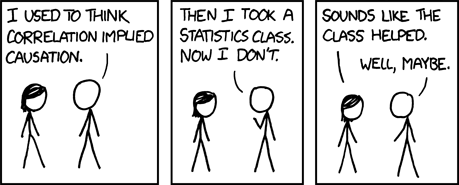
- Args About Causes: the stick-figure comic below.
Wednesday, September 23, 2009
Lonely Quiz
The quiz will be held at the beginning of class on Wednesday, September 30th. You'll have 25 minutes to take it, and it's worth 10% of your overall grade.
The quiz is on our tiny textbook (A Rulebook for Arguments). There will be a section on evaluating deductive arguments, and a section on evaluating the other kinds of arguments (example, analogy, authority, cause). Basically, the quiz will look a lot like the group work we've done in class so far.

The quiz is on our tiny textbook (A Rulebook for Arguments). There will be a section on evaluating deductive arguments, and a section on evaluating the other kinds of arguments (example, analogy, authority, cause). Basically, the quiz will look a lot like the group work we've done in class so far.
Tuesday, September 22, 2009
Penguin Digestion Experts? You Bet!
So you didn't believe me when I said that there are experts on the subject of penguin digestion? Oh, you did? Fine, well, I'll prove it to you, anyway. Here are some academic articles on the topic:
Perhaps my favorite, though, is the following:
- Adjustments of gastric pH, motility and temperature during long-term preservation of stomach contents in free-ranging incubating king penguins from a 2004 issue of Journal of Experimental Biology
- Feeding Behavior of Free-Ranging King Penguins (Aptenodytes Patagonicus) from a 1994 issue of Ecology
Perhaps my favorite, though, is the following:
- Pressures produced when penguins pooh—calculations on avian defaecation from a 2003 issue of Polar Biology
Saturday, September 19, 2009
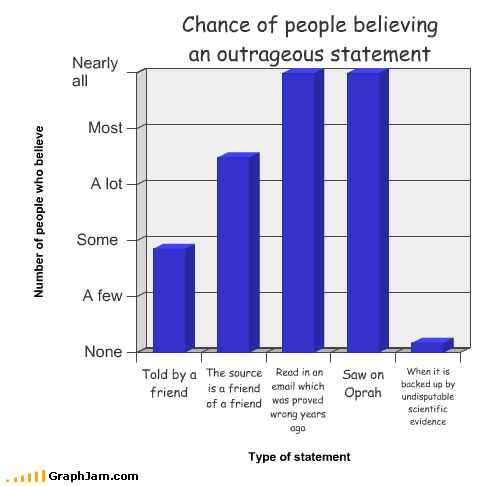
Wednesday, September 16, 2009
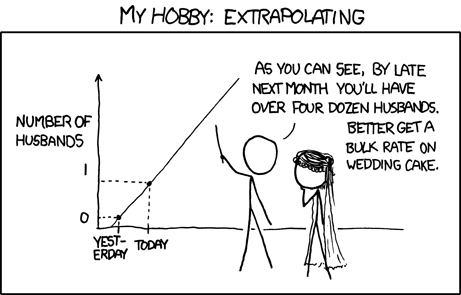
Arguments by Example
Here's a few dumb things about arguments by example (also called inductive arguments, talked about in the book chapter titled "Generalizations"). First, a video of comedian Lewis Black describing his failure to learn from experience every year around Halloween:
And here's a stick figure comic about scientists' efforts to get as big a sample size as they can to improve their arguments.
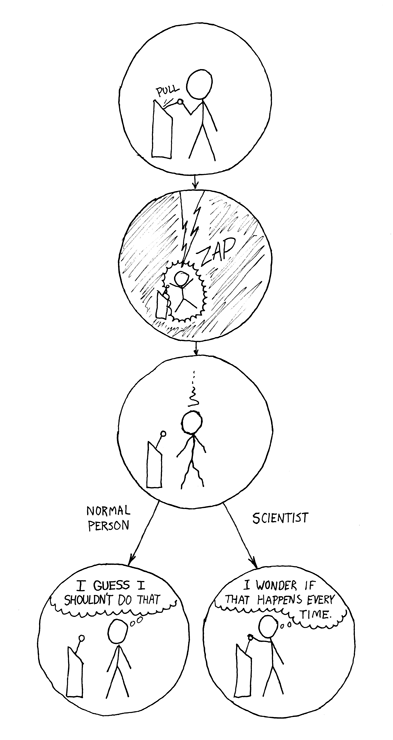
And here's a stick figure comic about scientists' efforts to get as big a sample size as they can to improve their arguments.
Tuesday, September 15, 2009
Structure
One of the trickier concepts to understand in this course is the structure of an argument. This is a more detailed explanation of the term. If you've been struggling to understand this term, the following might help you.
An argument's structure is its underlying logic; the way the premises and conclusion logically relate to one another. The structure of an argument is entirely separate from the actual meaning of the premises. For instance, the following three arguments, even though they're talking about different things, have the exact same structure:
1) All tigers have stripes.
Tony is a tiger.
Tony has stripes.
2) All humans have wings.
Sean is a human.
Sean has wings.
3) All blurgles have glorps.
Xerxon is a blurgle.
Xerxon has glorps.
There are, of course, other, non-structural differences in these three arguments. For instance, the tiger argument is overall good, since it has a good structure AND true premises. The human/wings argument is overall bad, since it has a false premise. And the blurgles argument is just crazy, since it uses made up words. Still, all three arguments have the same underlying structure (a good structure):
All A's have B's.
x is an A.
x has B's.
Evaluating the structure of an argument is tricky. Here's the main idea regarding what counts as a good structure: the premises, if they were true, would provide good evidence for us to believe that the conclusion is true. So, if you believed the premises, they would convince you that the conclusion is worth believing, too.
Note I did NOT say that the premises are actually true in a good-structured argument. Structure is only about truth-preservation, not about whether the premises are actually true or false. What's "truth preservation" mean? Well, truth-preserving arguments are those whose structures guarantee that if you stick in true premises, you get a true conclusion.
The premises you've actually stuck into this particular structure could be good (true) or bad (false). That's what makes evaluating an arg's structure so weird. To check the structure, you have to ignore what you actually know about the premises being true or false.
Good Structured Deductive Args (Valid)
If we assume that all the premises are true, then the conclusion must also be true for an argument to have a good structure. Notice we are only assuming truth, not guaranteeing it. Again, this makes sense, because we’re truth-preservers: if the premises are true, the conclusion that follows must be true.
EXAMPLES:
1) All humans are mammals.
All mammals have hair.
All humans have hair.
2) If it snows, then it’s below 32 degrees.
It is snowing right now.
It’s below 32 degrees right now.
3) All humans are mammals.
All mammals have wings.
All humans have wings.
4) Either Yao is tall or Spud is tall.
Yao is not tall.
Therefore, Spud is tall.
Even though arguments 3 and 4 are ultimately bad, they still have good structure (their underlying form is good). The second premise of argument 3 is false—not all mammals have wings—but it has the same exact structure of argument 1—a good structure. Same with argument 4: the second premise is false (Yao Ming is about 7 feet tall), but the structure is good (it’s either this or that; it’s not this; therefore, it’s that).
To evaluate the structure, then, assume that all the premises are true. Imagine a world in which all the premises are true. In that world, MUST the conclusion also be true? Or can you imagine a scenario in that world in which the premises are true, but the conclusion is still false? If you can imagine this situation, then the argument's structure is bad. If you cannot, then the argument is truth-preserving (inputting truths guarantees a true output), and thus the structure is good.
Bad Structured Deductive Args (Invalid)
In an argument with a bad structure, you can’t draw the conclusion from the premises – they don’t naturally follow. Bad structured arguments do not preserve truth.
EXAMPLES:
1) All humans are mammals.
All whales are mammals.
All humans are whales.
2) If it snows, then it’s below 32 degrees.
It doesn’t snow.
It’s not below 32 degrees.
3) All humans are mammals.
All students in our class are mammals.
All students in our class are humans.
4) Either Yao is tall or Spud is short.
Yao is tall.
Spud is short.
Even though arguments 3 and 4 have all true premises and a true conclusion, they are still have a bad structure, because their form is bad. Argument 3 has the same exact structure as argument 1—a bad structure (it doesn’t preserve truth).
Even though in the real world the premises and conclusion of argument 3 are true, we can imagine a world in which all the premises of argument 3 are true, yet the conclusion is false. For instance, imagine that our school starts letting whales take classes. The second premise would still be true, but the conclusion would then be false.
The same goes for argument 4: even though Spud is short (Spud Webb is around 5 feet tall), this argument doesn’t guarantee this. The structure is bad (it’s either this or that; it’s this; therefore, it’s that, too.). We can imagine a world in which Yao is tall, the first premise is true, and yet Spud is tall, too.

An argument's structure is its underlying logic; the way the premises and conclusion logically relate to one another. The structure of an argument is entirely separate from the actual meaning of the premises. For instance, the following three arguments, even though they're talking about different things, have the exact same structure:
1) All tigers have stripes.
Tony is a tiger.
Tony has stripes.
2) All humans have wings.
Sean is a human.
Sean has wings.
3) All blurgles have glorps.
Xerxon is a blurgle.
Xerxon has glorps.
There are, of course, other, non-structural differences in these three arguments. For instance, the tiger argument is overall good, since it has a good structure AND true premises. The human/wings argument is overall bad, since it has a false premise. And the blurgles argument is just crazy, since it uses made up words. Still, all three arguments have the same underlying structure (a good structure):
All A's have B's.
x is an A.
x has B's.
Evaluating the structure of an argument is tricky. Here's the main idea regarding what counts as a good structure: the premises, if they were true, would provide good evidence for us to believe that the conclusion is true. So, if you believed the premises, they would convince you that the conclusion is worth believing, too.
Note I did NOT say that the premises are actually true in a good-structured argument. Structure is only about truth-preservation, not about whether the premises are actually true or false. What's "truth preservation" mean? Well, truth-preserving arguments are those whose structures guarantee that if you stick in true premises, you get a true conclusion.
The premises you've actually stuck into this particular structure could be good (true) or bad (false). That's what makes evaluating an arg's structure so weird. To check the structure, you have to ignore what you actually know about the premises being true or false.
Good Structured Deductive Args (Valid)
If we assume that all the premises are true, then the conclusion must also be true for an argument to have a good structure. Notice we are only assuming truth, not guaranteeing it. Again, this makes sense, because we’re truth-preservers: if the premises are true, the conclusion that follows must be true.
EXAMPLES:
1) All humans are mammals.
All mammals have hair.
All humans have hair.
2) If it snows, then it’s below 32 degrees.
It is snowing right now.
It’s below 32 degrees right now.
3) All humans are mammals.
All mammals have wings.
All humans have wings.
4) Either Yao is tall or Spud is tall.
Yao is not tall.
Therefore, Spud is tall.
Even though arguments 3 and 4 are ultimately bad, they still have good structure (their underlying form is good). The second premise of argument 3 is false—not all mammals have wings—but it has the same exact structure of argument 1—a good structure. Same with argument 4: the second premise is false (Yao Ming is about 7 feet tall), but the structure is good (it’s either this or that; it’s not this; therefore, it’s that).
To evaluate the structure, then, assume that all the premises are true. Imagine a world in which all the premises are true. In that world, MUST the conclusion also be true? Or can you imagine a scenario in that world in which the premises are true, but the conclusion is still false? If you can imagine this situation, then the argument's structure is bad. If you cannot, then the argument is truth-preserving (inputting truths guarantees a true output), and thus the structure is good.
Bad Structured Deductive Args (Invalid)
In an argument with a bad structure, you can’t draw the conclusion from the premises – they don’t naturally follow. Bad structured arguments do not preserve truth.
EXAMPLES:
1) All humans are mammals.
All whales are mammals.
All humans are whales.
2) If it snows, then it’s below 32 degrees.
It doesn’t snow.
It’s not below 32 degrees.
3) All humans are mammals.
All students in our class are mammals.
All students in our class are humans.
4) Either Yao is tall or Spud is short.
Yao is tall.
Spud is short.
Even though arguments 3 and 4 have all true premises and a true conclusion, they are still have a bad structure, because their form is bad. Argument 3 has the same exact structure as argument 1—a bad structure (it doesn’t preserve truth).
Even though in the real world the premises and conclusion of argument 3 are true, we can imagine a world in which all the premises of argument 3 are true, yet the conclusion is false. For instance, imagine that our school starts letting whales take classes. The second premise would still be true, but the conclusion would then be false.
The same goes for argument 4: even though Spud is short (Spud Webb is around 5 feet tall), this argument doesn’t guarantee this. The structure is bad (it’s either this or that; it’s this; therefore, it’s that, too.). We can imagine a world in which Yao is tall, the first premise is true, and yet Spud is tall, too.
Wednesday, September 9, 2009
Club Meeting
 So, I run a club called "Owning Our Ignorance" that's devoted to fun and reasoning, but more funning than reasoning. Shut up, "funning" is too a word.
We're having our first meeting of the school year Sunday night at the Barnes & Noble in Deptford. More info on the meeting and the club are available here.
If you're interested, come on out!
Sunday, September 6, 2009
Definitions of "Philosophy"
Here are some videos on the definitions of the word "philosophy" that we discussed in class. First, the Bobby Brown definition: Nothing says "philosophy as a worldview" like 1988 Bobby Brown.
Bobby Brown - My Prerogative
Now for the 3-year-old definition. Here's comedian Louis CK's take on the broad, fundamental questions kids ask.
Louis CK - Why?
And here's what springs to my mind when I think about doing philosophy:

Wednesday, September 2, 2009
Email Subscription
So why does this course have a blog? Well, why is anything anything?
A blog (short for “web log”) is a website that works like a journal – users write posts that are sorted by date based on when they were written. You can find important course information (like assignments, due dates, reading schedules, etc.) on the blog. I’ll also be updating the blog throughout the semester, posting interesting items related to the stuff we’re currently discussing in class. You don't have to visit the blog if you don't want to. It's just a helpful resource. I've used a blog for this course a lot, and it's seemed helpful. Hopefully it can benefit our course, too.
Since I’ll be updating the blog a lot throughout the semester, you should check it frequently. There are, however, some convenient ways to do this without simply going to the blog each day. The best way to do this is by getting an email subscription, so any new blog post I write automatically gets emailed to you. (You can also subscribe to the rss feed, if you know what that means.) To get an email subscription:
1. Go to http://cccphilosophy09.blogspot.com.
2. At the main page, enter your email address at the top of the right column (under “EMAIL SUBSCRIPTION: Enter your Email”) and click the "Subscribe me!" button.
3. This will take you to a new page. Follow the directions under #2, where it says “To help stop spam, please type the text here that you see in the image below. Visually impaired or blind users should contact support by email.” Once you type the text, click the "Subscribe me!" button again.
4. You'll then get an email regarding the blog subscription. (Check your spam folder if you haven’t received an email after a day.) You have to confirm your registration. Do so by clicking on the "Click here to activate your account" link in the email you receive.
5. This will bring you to a page that says "Your subscription is confirmed!" Now you're subscribed.
If you are unsure whether you've subscribed, ask me (609-980-8367; slandis@camdencc.edu). I can check who's subscribed and who hasn't.

A blog (short for “web log”) is a website that works like a journal – users write posts that are sorted by date based on when they were written. You can find important course information (like assignments, due dates, reading schedules, etc.) on the blog. I’ll also be updating the blog throughout the semester, posting interesting items related to the stuff we’re currently discussing in class. You don't have to visit the blog if you don't want to. It's just a helpful resource. I've used a blog for this course a lot, and it's seemed helpful. Hopefully it can benefit our course, too.
Since I’ll be updating the blog a lot throughout the semester, you should check it frequently. There are, however, some convenient ways to do this without simply going to the blog each day. The best way to do this is by getting an email subscription, so any new blog post I write automatically gets emailed to you. (You can also subscribe to the rss feed, if you know what that means.) To get an email subscription:
1. Go to http://cccphilosophy09.blogspot.com.
2. At the main page, enter your email address at the top of the right column (under “EMAIL SUBSCRIPTION: Enter your Email”) and click the "Subscribe me!" button.
3. This will take you to a new page. Follow the directions under #2, where it says “To help stop spam, please type the text here that you see in the image below. Visually impaired or blind users should contact support by email.” Once you type the text, click the "Subscribe me!" button again.
4. You'll then get an email regarding the blog subscription. (Check your spam folder if you haven’t received an email after a day.) You have to confirm your registration. Do so by clicking on the "Click here to activate your account" link in the email you receive.
5. This will bring you to a page that says "Your subscription is confirmed!" Now you're subscribed.
If you are unsure whether you've subscribed, ask me (609-980-8367; slandis@camdencc.edu). I can check who's subscribed and who hasn't.
Monday, August 31, 2009
Course Details
Introduction to Philosophy
Camden County College, Blackwood Campus
Philosophy 101, Section 01
Fall 2009
Monday, Wednesday, Friday: 11:00 a.m. – 11:50 a.m.
Madison Hall, Room 311
Camden County College, Blackwood Campus
Philosophy 101, Section 01
Fall 2009
Monday, Wednesday, Friday: 11:00 a.m. – 11:50 a.m.
Madison Hall, Room 311
Instructor: Sean Landis
Email: slandis@camdencc.edu
Phone: 609-980-8367
Course Website: http://cccphilosophy09.blogspot.com
Required Texts
A Rulebook for Arguments, 3rd Edition, Anthony Weston (RA)
Classics of Western Philosophy, 7th Edition, Steven M. Cahn (CWP)
About the Course
This course is designed to introduce students to philosophy. Throughout the semester, we will explore a handful of classic philosophical questions: What is knowledge, and what can we know? What evidence is there regarding the existence of a God? Do humans have free will? What does it mean to say that one thing is morally right and another is morally wrong?
In examining these issues, it is my hope that we can also develop the skills of doing philosophy—understanding philosophical arguments, evaluating the quality of such arguments, and developing good arguments of our own on philosophical topics. Our main goal is for each of us to come to appreciate the value of sitting and thinking. Long, careful, systematic, detailed thought is a great tool for increasing understanding on complex topics.
Grades
900-1000 points = A
800-899 points = B
700-799 points = C
600-699 points = D
below 600 points = F.
Quiz 100 points
Midterm 200 points
Final 250 points
2 Short Papers 50 points each
Journal 150 points
Group Presentation 150 points
Attendance/Participation 50 points
Quiz: There will only be one quiz, held at the end of arguments section of the course. The quiz will last 20 or 25 minutes, and be held at the beginning of class on the scheduled day.
Exams: There will be a midterm and a final exam. The midterm tests everything covered during the first half of the course, and will last the full period (50 minutes) on the scheduled day. The final exam is cumulative—that is, it tests everything covered throughout the whole course. The final will last 50 minutes, and will take place on the last day of class.
Papers: There will be 2 papers (about 2 pages long each), the first on our section on knowledge, and the second on our section on ethics.
Journal: Each student will keep a journal during our section on the existence of God and free will.
Group Presentation: There will be a group project presented in front of the class toward the end of the semester. Each group of 3 to 6 students will research a topic in philosophy not discussed in class, and present a 10- to 15-minute lesson on it to the rest of class.
Attendance/Participation: Most of this will be based on your attendance. If you’re there every class, you’ll get full credit for your attendance grade. In addition, there will be a lot of informal group work throughout the semester in which students get together to analyze the readings or philosophical issues being discussed in class. Group work can impact your grade.
Extra Credit: I like giving extra credit! I’ll be giving some official extra credit assignments throughout the semester. I’ll also be offering some extra credit points more informally during class time. Remind me about this if I slack off on dishing out extra credit points.
Classroom Policies
Academic Integrity: Cheating and plagiarism (using someone else’s words or ideas in a paper or assignment without giving credit to the source) will not be tolerated in the class. Students found guilty of either will definitely fail the exam or assignment—and possibly the entire class. FYI: I’m pretty good at catching plagiarists. I recommend not trying it!
Excused Absenses: Make-up exams, quizzes, in-class projects, and oral reports will only be rescheduled for any excused absences (excused absences include religious observance, official college business, and illness or injury – with a doctor’s note). An unexcused absence on the day of any assignment or test will result in a zero on that assignment or test.

Important Dates
September 1st: Last day to drop & receive a 100% refund.
September 16th: Last day to drop & receive a 50% refund.
September 23rd: Last day to sign up to audit a course.
December 4th: Last day to withdraw from Fall Classes.
Course Schedule
Sept. 2—4: Intro to Class/Arguments
Wednesday Introduction to Class (no reading)
Friday Doing Philosophy (no reading)
September 7—11: Arguments
Monday LABOR DAY (no class)
Wednesday Arguments (RA Chapters 1 and 2)
Friday Types of Arguments (RA 3-5); group work
September 14—18: Arguments
Monday Deductive Arguments (RA Chapters 6)
Wednesday Deductive Arguments (RA Chapters 6); group work
Friday Writing Essays (RA Chapters 7-9)
September 21—25: Arguments
Monday Writing Essays (RA Chapters 7-9); group work
Wednesday Fallacies (RA Chapter 10)
Friday Fallacies & Psychological Impediments (handout); group work
September 28—October 2: Knowledge
Monday QUIZ #1; Intro to Knowledge (no reading)
Wednesday Plato (handout)
Friday Descartes: Meditations One and Two (CWP 482-483, 490-496)
October 5—9: Knowledge
Monday Descartes continued (no reading)
Wednesday Bostrom: “Do We Live in a Computer Simulation?” (handout); group work
Friday Hume: An Enquiry Concerning Human Understanding Sections 2-4 (CWP 761-762, 767-773)
October 12—16: Knowledge/The Existence of God
Monday Hume continued; group work
Wednesday PAPER #1 due; Aquinas: Summa Theologiae Question 2 (CWP 440-441, 450-453)
Friday Aquinas: Summa Theologiae Question 2 (CWP 440-441, 450-453); group work
October 19—23: Existence of God
Monday Anselm: Chapters 2—5 in Proslogian (CWP 411-412, 415-416)
Wednesday Review for Midterm (no reading)
Friday MIDTERM
October 26—30: Existence of God
Monday Gaunilo: Guanilo’s Reply on Behalf of the Fool (CWP 425-427)
Wednesday Anselm & Guanilo (no reading); group work
Friday Hume: Parts II & V in Dialogues Concerning Natural Religion (CWP 862-867, 873-875)
November 2—7: Existence of God
Monday Hume (continued)
Wednesday Augustine: Books 1, 2, & part of 3 of On Free Choice of the Will (CWP 357-369)
Friday Augustine (continued); group work
November 9—13: Existence of God/Free Will
Monday Hicks (handout)
Wednesday Problem of Evil wrap-up (no reading); group work
Friday Maimonides: The Guide of the Perplexed (CWP 434-439)
November 16—20: Free Will
Monday Aristotle: Book III of On the Soul (CWP 223-227)
Wednesday Hospers (handout)
Friday Free Will wrap-up (no reading); group work
November 23—25: Ethics
Monday Mill: Part of Chapter 2 in Utilitarianism (CWP 1060-1063)
Wednesday Journal due; Kant: First Section in Grounding for the Metaphysics of Morals (CWP 984-991)
Friday THANKSGIVING BREAK (no class!) (woo?)
November 30—December 4: Ethics
Monday Aristotle: Book III, Chapter 1 in Nicomachean Ethics (CWP 275-277)
Wednesday Aristotle: All of Book II of Nicomachean Ethics (CWP 269-275)
Friday Ethics wrap up (no new reading)
December 7—11: Ethics/Group Presentations
Monday PAPER #2 due; preparation for presentations (no reading)
Wednesday group presentations
Friday group presentations
December 14—18: Review/Final Exam
Monday group presentations
Wednesday review for Final Exam
Friday FINAL EXAM

Wednesday Introduction to Class (no reading)
Friday Doing Philosophy (no reading)
September 7—11: Arguments
Monday LABOR DAY (no class)
Wednesday Arguments (RA Chapters 1 and 2)
Friday Types of Arguments (RA 3-5); group work
September 14—18: Arguments
Monday Deductive Arguments (RA Chapters 6)
Wednesday Deductive Arguments (RA Chapters 6); group work
Friday Writing Essays (RA Chapters 7-9)
September 21—25: Arguments
Monday Writing Essays (RA Chapters 7-9); group work
Wednesday Fallacies (RA Chapter 10)
Friday Fallacies & Psychological Impediments (handout); group work
September 28—October 2: Knowledge
Monday QUIZ #1; Intro to Knowledge (no reading)
Wednesday Plato (handout)
Friday Descartes: Meditations One and Two (CWP 482-483, 490-496)
October 5—9: Knowledge
Monday Descartes continued (no reading)
Wednesday Bostrom: “Do We Live in a Computer Simulation?” (handout); group work
Friday Hume: An Enquiry Concerning Human Understanding Sections 2-4 (CWP 761-762, 767-773)
October 12—16: Knowledge/The Existence of God
Monday Hume continued; group work
Wednesday PAPER #1 due; Aquinas: Summa Theologiae Question 2 (CWP 440-441, 450-453)
Friday Aquinas: Summa Theologiae Question 2 (CWP 440-441, 450-453); group work
October 19—23: Existence of God
Monday Anselm: Chapters 2—5 in Proslogian (CWP 411-412, 415-416)
Wednesday Review for Midterm (no reading)
Friday MIDTERM
October 26—30: Existence of God
Monday Gaunilo: Guanilo’s Reply on Behalf of the Fool (CWP 425-427)
Wednesday Anselm & Guanilo (no reading); group work
Friday Hume: Parts II & V in Dialogues Concerning Natural Religion (CWP 862-867, 873-875)
November 2—7: Existence of God
Monday Hume (continued)
Wednesday Augustine: Books 1, 2, & part of 3 of On Free Choice of the Will (CWP 357-369)
Friday Augustine (continued); group work
November 9—13: Existence of God/Free Will
Monday Hicks (handout)
Wednesday Problem of Evil wrap-up (no reading); group work
Friday Maimonides: The Guide of the Perplexed (CWP 434-439)
November 16—20: Free Will
Monday Aristotle: Book III of On the Soul (CWP 223-227)
Wednesday Hospers (handout)
Friday Free Will wrap-up (no reading); group work
November 23—25: Ethics
Monday Mill: Part of Chapter 2 in Utilitarianism (CWP 1060-1063)
Wednesday Journal due; Kant: First Section in Grounding for the Metaphysics of Morals (CWP 984-991)
Friday THANKSGIVING BREAK (no class!) (woo?)
November 30—December 4: Ethics
Monday Aristotle: Book III, Chapter 1 in Nicomachean Ethics (CWP 275-277)
Wednesday Aristotle: All of Book II of Nicomachean Ethics (CWP 269-275)
Friday Ethics wrap up (no new reading)
December 7—11: Ethics/Group Presentations
Monday PAPER #2 due; preparation for presentations (no reading)
Wednesday group presentations
Friday group presentations
December 14—18: Review/Final Exam
Monday group presentations
Wednesday review for Final Exam
Friday FINAL EXAM
Subscribe to:
Comments (Atom)